
FAQs – United States Entry Waivers
Here you will find an extensive list of questions and answers relating to the US entry waiver process.
If you are unclear on whether or not you need a US Entry Waiver or instead require removal of your criminal record here is how it works. To learn about removing a criminal record click here for pardons Canada information.
- If you have been refused entry at the border or deported the American government will deem you inadmissible and you will require a US entry waiver.
- If you have a criminal record are you likely inadmissible.
- If you have a medical condition you may be inadmissible.
- If you have overstayed your welcome you are likely inadmissible.
Below is an extensive list of question and answers that we feel covers just about any question you might have concerning US entry waivers. But if your question isn’t here just give us a call or send us an email and we will be happy to answer it for you.
Introduction to US entry waivers
What is a US entry waiver?
A US entry waiver in an application submitted to the American government in order to overcome inadmissibility status at the United States border.
What is inadmissibility?
Inadmissibility simply means you are not allowed to enter the country which, in this case, is the United States of America. A person can be deemed inadmissible to the United States for having a criminal record, having overstayed their welcome and/or having a medical condition.
Since the most common country for Canadians to visit is the USA being deemed inadmissible poses a serious mobility problem for thousand of Canadians each year.
For more information:
https://help.cbp.gov/app/answers/detail/a_id/760/~/entry-into-the-u.s.—canadian-with-criminal-record-or-overstay,-waiver
What is the Immigration and Nationality Act
The Immigration and Nationality Act (INA) was enacted in 1951 in order to restructure American immigration law that was largely disorganized among States and other jurisdictions in the United States. It essentially centralized and standardized American immigration law at the time but has since been amended many times.
For the purpose of applying for a US entry waiver it is not important to be familiar with this law.
For more information:
http://www.uscis.gov/laws/immigration-and-nationality-act
Can I be deemed inadmissible for a criminal record?
What are crimes of moral turpitude?
“Crimes of moral turpitude” is a legal concept in the United States that refers to conduct in which a person has transgressed the boundaries of what is considered “decent and morally acceptable in society”.
Technically, a person should only be found criminally inadmissible to the United States for a crime that falls under the moral turpitude category. However, the term “moral turpitude” is hardly exact and in our experience United States border agents do not apply this criteria reliably or consistently.
In our opinion you can be at risk of being refused entry to the United States for any criminal record.
For more information:
https://en.wikipedia.org/wiki/Moral_turpitude
https://nationalpardon.org/drunk-drivingimpaired-drivingdriving-over-0-08-dui/
https://help.cbp.gov/app/answers/detail/a_id/402/related/1
https://help.cbp.gov/app/answers/detail/a_id/1282/related/1/session/L2F2LzEvdGltZS8xNDUwMzY0Njk0L3NpZC85c0I2Z2NFbQ%3D%3D
Can I be deemed inadmissible to the United States if I was arrested but not found guilty?
In our experience you can easily be refused entry for non convictions, particularly if there are arrests involving drugs or other controlled substances. When crossing the border it is best not to take chances. If there are non convictions showing we strongly advise taking care of them before attempting to enter the United States.
Can I be deemed inadmissible to the United States if I previously overstayed my welcome?
Yes. Overstaying your welcome is one of the most common reasons for Canadians requiring a US entry waiver.
Can I be deemed inadmissible to the United States if I was previously deported?
Yes. If you are deported from the United States you will automatically be considered inadmissible. In addition there could be additional filing fees with the American government for your I-212.
Can I be deemed inadmissible to the United States if I am sick?
Yes. If you have a communicable disease the American government will deem you inadmissible and you will have to apply for a US entry waiver.
For more information:
https://nationalpardon.org/us-waiver-restrictions-at-the-us-border/
https://nationalpardon.org/possession-controlled-substance/
https://nationalpardon.org/waiver-application-the-5-year-waiver/
Inadmissibility to the United States
Are there exceptions to criminal inadmissibility?
Technically there are exceptions to criminal admissibility but in our experience there is a discrepancy between what the law states and how the law is applied at the border. Take the following example from the American Customs and Border Protection Website:
At this time, driving under the influence, breaking and entering, disorderly conduct and simple assault are not considered crimes that make a person inadmissible to the U.S., although if there are multiple convictions and or other misdemeanors, you could be denied entry.
Source: https://help.cbp.gov/app/answers/detail/a_id/760/kw/waiver
In our experience the law is not applied evenly and we strongly advise taking steps to make sure you are not at risk of being refused prior to attempting to enter the United States.
What is medical inadmissibility?
Medical inadmissibility is just as it sounds. If you have a serious disease that is communicable you can be refused entry to the country.
Are there exceptions to medical inadmissibility?
If you simply have a cold, the common flu or any other illness that commonly circulates through the general population you should not be refused entry to the United States.
If I overstayed my welcome can I be denied entry?
Yes overstaying your welcome in the United States is reason enough to be deemed inadmissible on future trips.
If I was deported can I be denied entry?
Yes. Being deported will result in your being deemed inadmissible to the United States.
Processing a US entry waiver
What is the cost of a US entry waiver?
The cost of applying for a US entry waiver is determined partly by whether or not you hire a third party to prepare the documentation on your behalf. If you hire a lawyer the cost can be upwards of $10,000.
If you do not hire anyone you will be required to pay for any supporting documentation you need to request in addition to the American government filing fee .
The cost of having the National Pardon Centre prepare your waiver application is $930.
For more information:
https://nationalpardon.org/cost-of-a-waiver/
Can I do the application on my own?
Yes. It is possible to prepare your own US entry waiver application. However you will need to obtain RCMP certified fingerprints which cannot be done without a third party service provider.
The National Pardon Centre is an RCMP accredited fingerprinting agency that can handle your fingerprinting needs, even from abroad.
For more information:
https://nationalpardon.org/fingerprinting/
https://nationalpardon.org/why-is-it-that-i-have-to-submit-my-fingerprints-again/
How long does it take to apply for a US entry waiver?
The average turn-around time for a US entry waiver processed at the National Pardon Centre is 8 – 12 months, start to finish. Approximately half of that time is spent preparing the necessary documentation, while the other half is spent by the American government reviewing the application and then granting your entry waiver.
For more information:
https://nationalpardon.org/pardon-and-waiver-time-frames/
If my waiver is refused will I get a refund on your service fee?
No. But when you apply with the National Pardon Centre we promise to inform you honestly about your chances of success. We do not accept cases that we know will not be accepted. Furthermore if we feel there is a chance your application will not succeed we will consult you before proceeding and allow you to decide whether you would like to take the chance or not.
For more information:
https://help.cbp.gov/app/answers/detail/a_id/760/kw/waiver
Submitting your completed waiver application
Find a pre-clearance port of entry
CBP Headquarters
Director Field Operations
1300 Pennsylvania Ave – 1717 H St. Floor 6
CB-15 Mail Stop 1300
Washington, DC 20229
Questions/Customer Service
For general CBP inquiries, please call the CBP INFO Center Monday-Friday, between 8:30 a.m. and 5 p.m. Eastern Time.
General Inquiries: 1-877-CBP-5511
International Callers: (202) 325-8000
TDD: 1-866-880-6582
Calgary Preclearance
Calgary International Airport
P.O. Box 155
2000 Airport Road, Northeast
Calgary, Alberta, Canada T2E 6W5
(403) 221-1634
Edmonton Preclearance
Edmonton International Airport 2345,
1000 Airport Rd
Edmonton, Alberta, Canada T9E0V3
(780) 890-4515
Halifax Preclearance
Halifax Robert L. Stanfield International Airport Level 2
1 Bell Boulevard
Enfield, Nova Scotia, Canada B2T 1K2
(902) 873-7780
Montreal Preclearance
Montreal Trudeau International Airport
975 Romeo Vachon Boulevard, North
Room TT 2.400
Dorval, Quebec, Canada H4Y 1H1
(514) 636-3875
Ottawa Preclearance
Ottawa MacDonald-Cartier International Airport
1000 Airport Road, Private
Ottawa, Ontario, Canada K1V 9B4
(613) 523-8120
Toronto Preclearance
Lester B. Pearson International Airport
Prior to 12/02/15 Queue Times
P.O. Box 115
Toronto AMF
Toronto, Ontario, Canada L5P 1A2
(905) 676-2606
Vancouver Preclearance
Vancouver International Airport
International Terminal – Level 3
3161 Grant McConachie Way
Richmond, BC V7B 0A4
(604) 278-7422
Victoria Preclearance PO Box 1540
Port Angeles, Washington 98362
(250) 382-5131
Winnipeg Preclearance
Winnipeg International Airport
2311-1970 Wellington Avenue
Winnipeg, Manitoba, Canada R3H 0E3
(204) 783-2206
Find a land port of entry
Boston Field Office Port Address
Portland Port of Entry
312 Fore Street
Portland, ME 04101
Phone: (207) 771-3600
Fax: (207) 771-3608
Houlton Port of Entry
27 Customs Loop
Houlton, ME 04730
Phone: (207) 532-2131 x 0
Fax: (207) 532-4153
Fort Fairfield Port of Entry
4 Boundry 4 Line Road
Fort Fairfield, ME 04742
Phone: (207) 473-7474
Ft. Kent Port of Entry
401 West Main Street
Fort Kent, ME 04743
Phone: (207) 834-5255
Van Buren Port of Entry
137 Bridge Street, P.O. Box 146
Van Buren, ME 04785
Phone: (207) 868-3391
Madawaska Port of Entry
63 Bridge Avenue, Suite 101
Madawaska, ME 04756
Phone: (207) 728-4376 x 0
Calais Port of Entry
3 Customs Street
Calais, ME 04619
Phone: (207) 454-3621
Jackman Port of Entry
2614 Main Street
Sandy Bay Twp, ME 04945
Phone: (207) 668-3711
Highgate Springs Port of Entry
480 Welcome Center Road
Swanton, VT 05488
Phone: (802) 868-2778
Richford Port of Entry
705 Province Street
Richford, VT 05476
Phone: (802) 848-7766
Derby Line Port of Entry
107 Interstate 91 South
Derby Line, VT 05830
Phone: (802) 873-3219
Norton Port of Entry
115 Rte. 147 N.
Norton, VT 05907
Phone: (802) 822-5222
Buffalo Field Office Port Address
Buffalo – Peace Bridge Port of Entry
Monday – Thursday
5:00 PM – 9:00 PM (716)888-4926
Champlain – Port of Entry
Monday – Thursday
For an appointment call (518) 298-8346
Lewiston / Queenston Bridge Port of Entry
Monday – Thursday
2:00 PM – 9:00 PM(716)282-1500×353
Massena – Port of Entry
Monday – Thursday
9:00 AM – 3:00 PM
For an appointment call (315) 769-3091
Niagara Falls – Rainbow Bridge
Monday – Thursday
9:00 AM – 3:00 PM
Sunday (October- May only)
5:00 PM – 9:00 PM(716)284-5174×324
Ogdensburg – Port of Entry
Monday – Thursday
9:00 AM – 3:00 PM
For an appointment call (315) 393-1390
Thousand Islands Bridge Port of Entry (Alexandria Bay)
Monday – Thursday
9:00 AM – 3:00 PM
For an appointment call (315) 482-2065
Detroit Field Office Port Address
Detroit Canada Tunnel Port of Entry
150 E. Jefferson
Detroit, MI 48226
Blaine, WA 98230
Monday and Wednesday
8:00 AM – 4:00 PM(313)393-3793
Blue Water Bridge Port of Entry
1410 Elmwood
Port Huron, MI 48060
Monday-Friday
9:00 AM – 4:00 PM(810)632-8822
International Bridge Port of Entry
900 International Bridge Plaza
Sault Ste Marie, MI 49873
Monday-Friday
8:00 AM – 4:00 PM(906)632-8822
Seattle Field Office Port Address
Pacific Highway Port of Entry
9950 Pacific Highway
Blaine, WA 98230
Monday and Wednesday
9:00 AM – 3:00 PM(360)332-5771
Sumas Port of Entry
109 Cherry Street
Sumas, WA 98295
Tuesday and Friday
9:00 AM – 3:00 PM (360)988-4781
Lynden Port of Entry
9949 Guide Meridian Road
Lynden, WA 98264
Blaine, WA 98230
Thursday Only
9:00 AM – 3:00 PM(360)354-2183
Oroville Port of Entry
33643 Hwy 97 North
Oroville, WA 98844
Monday-Friday
9:00 AM – 3:00 PM(509)476-2955
Eastport Port of Entry
Highway 95 North
Eastport, ID 83826
Monday-Friday
9:00 AM – 3:00 PM(208)267-3966
Roosville Port of Entry
8395 Highway 93 North
Eureka, MT 59917
Monday-Friday
9:00 AM – 3:00 PM(406)889-3865
Sweetgrass Port of Entry
Interstate 15 North
Sweetgrass, MT 59484
Monday-Friday
9:00 AM – 3:00 PM(406)895-2664
Raymond Port of Entry
Highway 16 North
Raymond, MT 59256
Monday-Friday
9:00 AM – 3:00 PM(406)895-2664
Portal Port of Entry
301 W. Railway Ave
Portal, ND 58772
Monday-Friday
9:00 AM – 3:00 PM(701)926-4241
Pembina Port of Entry
112 W. Stutsman
Pembina, ND 58271
Monday-Friday
9:00 AM – 3:00 PM(701)825-6551
Dunseith Port of Entry
State Highway
Dunseith, ND 58239
Monday-Friday
9:00 AM – 3:00 PM(701)263-4460
International Falls Port of Entry
2nd Avenue
International Falls, MN 55649
Monday-Friday
9:00 AM – 3:00 PM(218)283-2541
Grand Portage Port of Entry
9403 Highway 61
Grand Portage, MN
Monday-Friday
9:00 AM – 3:00 PM(218)475-2244
Del Bonita Port of Entry
4071 Chalk Butte
41 miles north of Cut Bank on Hwy. 213
Cut Bank, MT 59427-9109
(406) 336-2130
Monday-Friday
9:00 AM – 3:00 PM
Morgan Port of Entry
53869 US Highway 191 N.
Loring, MT 59537-9600
(406) 674-5248
Monday-Friday
9:00 AM – 3:00 PM
Opheim Port of Entry
6071 State Highway 24 North
Opheim, MT 59250-0376
(406) 724-3212
Monday-Friday
9:00 AM – 3:00 PM
Piegan Port of Entry
10 miles North of Babb on Highway 89
Babb, MT 59411-0109
(406) 732-5572
Monday-Friday
9:00 AM – 3:00 PM
Scobey Port of Entry
HWY 13 North at Canadian Border
Scobey, MT 59263-2300
(406) 783-5375
Monday-Friday
9:00 AM – 3:00 PM
Turner Port of Entry
12 miles North of Turner on Highway 24
Loring, MT 59537-9600
(406) 379-2651
Monday-Friday
9:00 AM – 3:00 PM
Whitetail Port of Entry
Highway 511 North at Canadian Border
Whitetail, MT 59276-0038
(406) 779-3531
Monday-Friday
9:00 AM – 3:00 PM
Wild Horse Port of Entry
29966 Wild Horse Road, Highway 232
Havre, MT 59501-8058
(406) 394-2371
Monday-Friday
9:00 AM – 3:00 PM
Willow Creek Port of Entry
29942 St Joe Road
Havre, MT 59501-8072
(208) 267-5309
Monday-Friday
9:00 AM – 3:00 PM
Porthill Port of Entry
Highway 1 at Canadian Border
Loring, Porthill, ID 83853-0040
(218) 475-2244
Monday-Friday
9:00 AM – 3:00 PM
Baudette Port of Entry
PO Box 617, HWY 72 North
Baudette, MN 56623
Monday-Friday
9:00 AM – 3:00 PM(218)634-2803
Warroad Port of Entry
41781 State Highway 313
Warroad, MN
Monday-Friday
9:00 AM – 3:00 PM(218)386-2796
Peace Arch Port of Entry
100 Peace Portal Drive
Blaine, WA 98230
Monday-Friday
9:00 AM – 3:00 PM(360)332-2511
Danville Port of Entry
19130 Highway 21 N.
Danville, WA 99121
Monday-Friday
9:00 AM – 10:00 PM(509)779-4862
Laurier Port of Entry
27017 Highway 395 N.
Laurier, WA 99146
Monday-Friday
9:00 AM – 10:00 PM(509)684-0570
Frontier Port of Entry
4939 Highway 25 N.
Northport, WA 99157
Monday-Friday
9:00 AM – 3:00 PM(509)732-6215
Metaline Falls Port of Entry
26781 SR 31
Metaline Falls, WA 99153
Monday-Friday
9:00 AM – 10:00 PM(509)446-4421
Travelling with a US entry waiver
Should I keep a copy of my waiver on me at all times while in the United States?
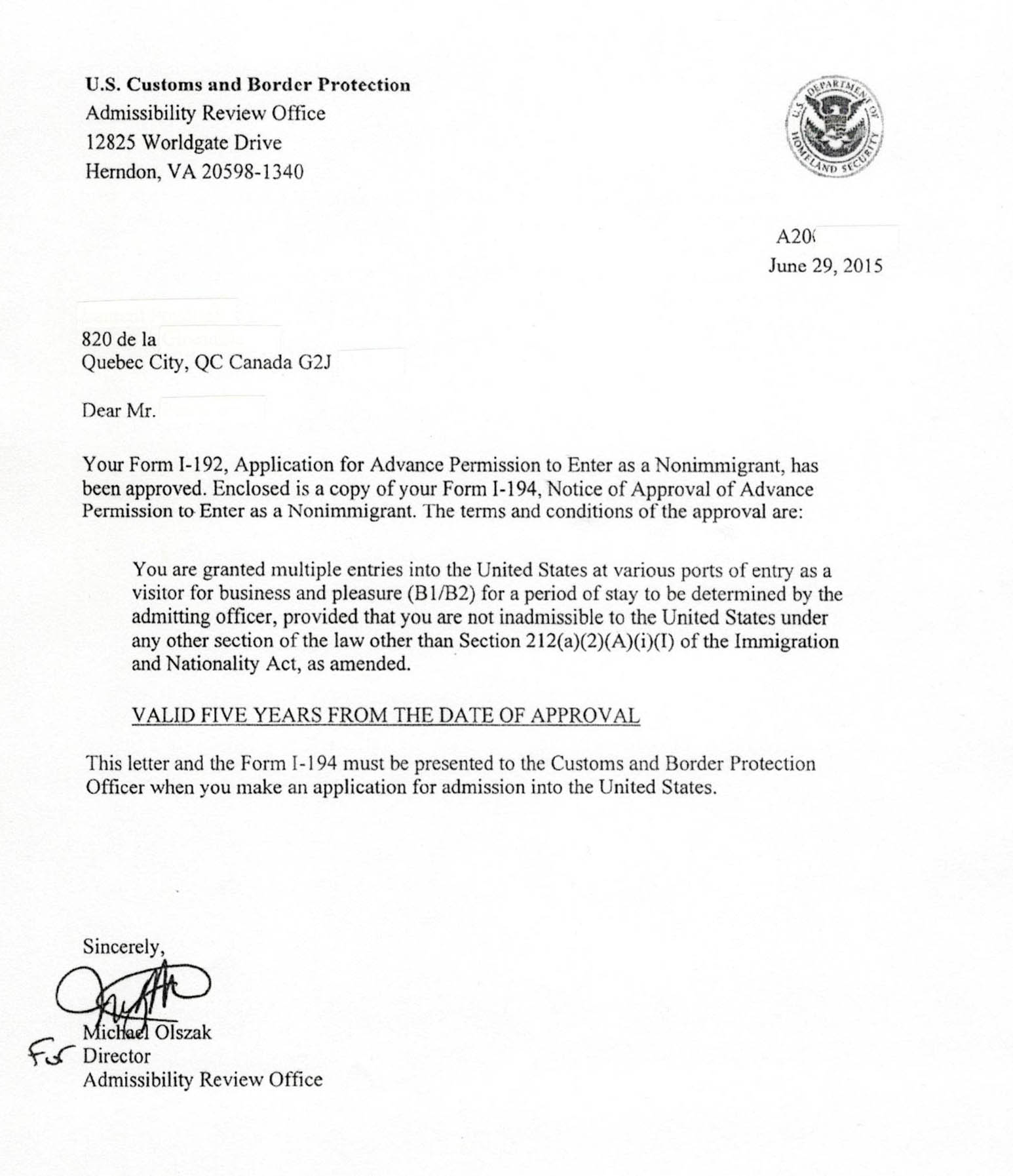
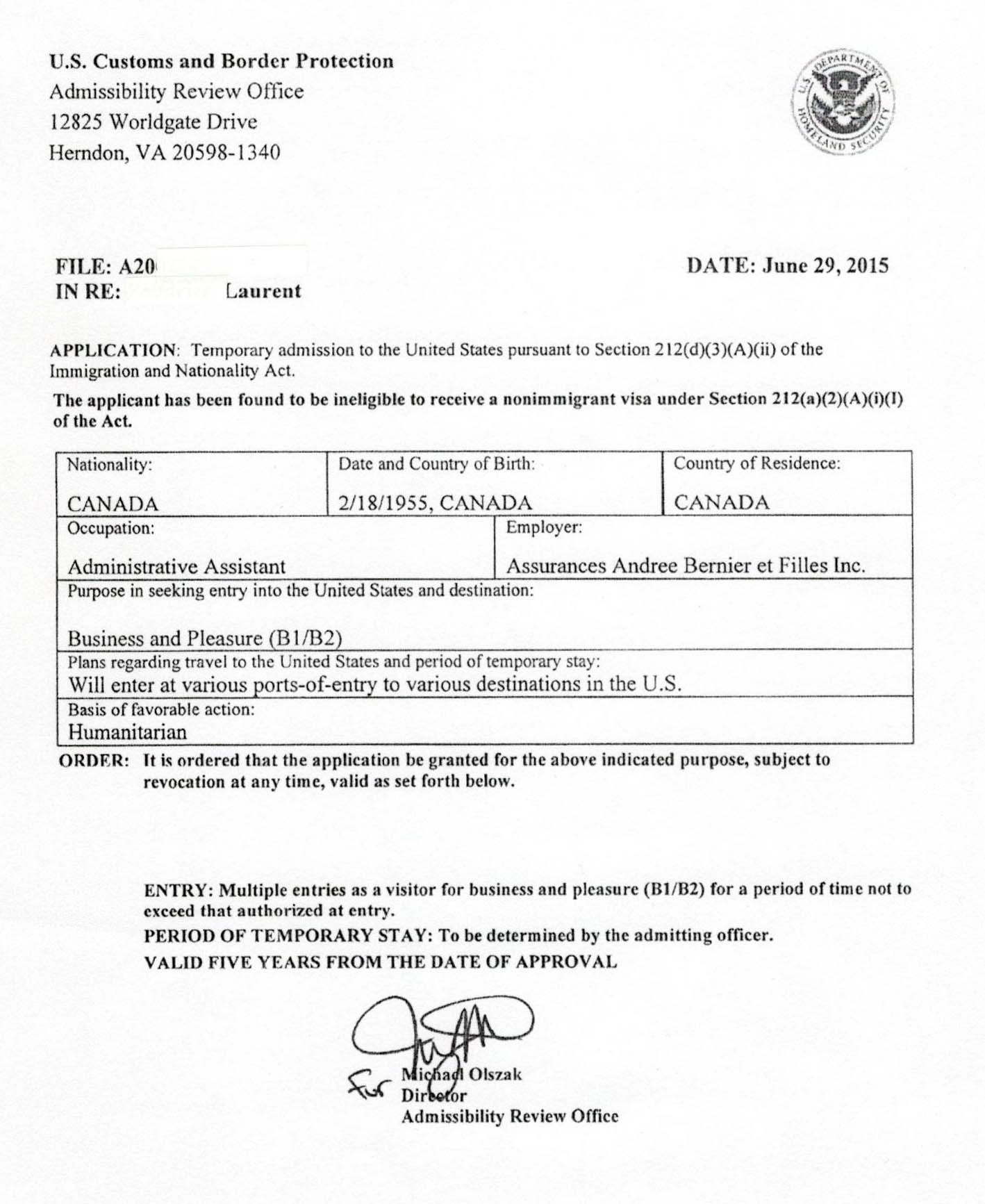
We don’t think this is necessary. We advise keeping a copy of your waiver on you whenever you are required to be in possession of your passport.
Should I show my waiver to the border agent when entering the United States?
We advise keeping your waiver with your passport. If your passport is requested you are required to show your US entry waiver as well.
Results of a US entry waiver application
How often can I use my US entry waiver?
A waiver allows you to travel to the United States with the same frequency and duration as any other admissible Canadian citizen.
Call us: 1-866-242-2411 8:30am – 5:00pm Monday to Friday